This is a true story.
Alvin Henry “Jack” Southford was born in Minnesota near Albert Lea or Minneapolis sometime around 1885. When he was of age he enlisted with the Marines and served along side Old Gimlet Eye himself at the Boxer Rebellion in China. After his tour he found his way to civilian work as a rail road conductor on the lines that served Charleston, South Carolina. That is where in 1915 he met his wife, Lily Dolan, with whom he had two children; Jack Jr (1916) and Jennie (1920).
For many years Jack would be out of town for long periods, the nature of his employment kept him outward bound. But by the late teens he had rejoined the service and was assigned as a pilot on the liberty boat out of Parris Island, local to Charleston and his growing family. An idyllic turn for the good.
Then in 1919 – disaster. Jack left for duty and never returned.
John Dolan was born in 1841 in Co. Longford Ireland, a luscious green rolling land besieged by war, famine, and violence. Sometime before 1878 he removed himself to Charleston, South Carolina where he married the daughter of Irish / English immigrants, Janie Keegan. They lived at 75 r Line Street, at the very northern edge of this tortured city named for a dead King.
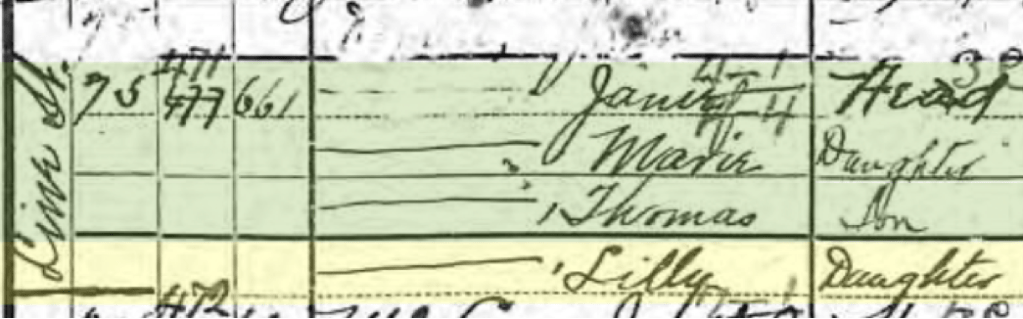
This was Charleston after the Civil War, in which Dolan himself was injured during the failed defense of this same city at the opening bell of the conflict. Appropriate to its relationship with American institutionalized slavery, the peninsula city saw heavy damage – all but razed – and was then further insulted by an earthquake in 1866. A Baptism of death left whatever the slaving port of “Charles Town” had been in the past and upon the freshly exposed floor of the urban forest would grow new and foreign foliage. Charleston had been the capital of slavery whereby it had grown rich and decadent; both features it would now wear awkwardly like a dead grandfathers overlarge suit in the post slavery reconstruction South.
Our action begins in a hovel on 75 r Line Street, which runs approximately east – west and was once the northern termination of the city. Old maps show an 1830’s era fortification wall running parallel to Line; today the street is tucked in the middle of Charleston and oppressed by the massive Eisenhower era highway that hangs over the topography like a juggernaut. Whole neighborhoods razed or dissected. The “necessities” of society erase that which is easiest to erase and this illustrates the capitalist stratification thereof. We encounter this refrain often: it’s usually the poor who suffer. History reveals the tricks of the magician. As we will see, the “blight” of the rough and tumble neighborhoods is once and again simply removed (from geography and history) rather than rejuvenated.
Scant few blocks east of this vernacular two unit abode at 75 r Line St. lays the Southern Line rail road which runs north out of town. A new development. Pulsing like organs on pulmonary rails had come the slow crawling sprawl of industrialism. Red brick, rust iron, noise, smog, and dirt class workers perfumed in the grease of labor. The metropolis presented itself as an alternative to the slow life on the farm toiling over dead soil and harvesting meals out of stones. The torment of the Civil War had left a smoldering vacuum of power and influence and bricky northern capital rushed in to fill the void with factories and packing plants. An exponentially constant industrial thrum. Growth without foreseeable end.
Miss Lily Dolan was born of John and Janie into this chaos on May 10th, 1885 in concert with the birth and death of her twin sister, Veronica Ignatius, whose name meant Truth and Fire. Miss Lily, Elizabeth Josephine, meant “God is my Oath” and “Closer to Jehovah”.
Lily was born with two older sisters: Marie, six years old, and Jeanne Marceline planted between them at three. In 1889 a younger brother named Thomas was born. Jeanne died five years later of “gastric fever” – typhoid – absolutely terrifying and she was only 12 years old. Shortly thereafter she was followed into oblivion by her father John, who died in 1896, at the age of fifty-five. Whatever his Irish eyes had seen between County Longford and his dismissal from this green Earth passed into oblivion with him.
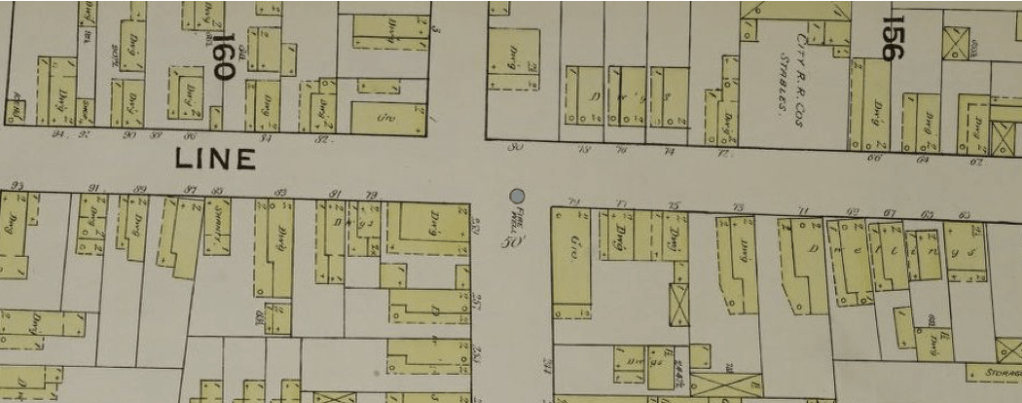
On the first day of the new century, 1900, Lily was fifteen, with an unemployed and widowed immigrant mother, twenty-one year old sister and eleven year old brother. Crammed together on the center-edge of the ramshackle and “working class” Elliotborough. Lily and her family lived in the cheap part of a broken city, with capital leeching what it could from the empoverished labor class. Broken families and broken people.
Sometime before 1904 the remaining Dolans moved to 62 r Line street, just down the block. We can only speculate as to the reason for the move. Unlike the house at 75 Line, 62 stands today so we may evaluate it. A small two story structure with two abodes smashed into it. 750 square feet for four adults if the math works out. Lily and her older sister Marie (most often called “Mamie”) worked consistently at a bag factory, one of the many textile factories appended to the arteries of the rail road. Thomas for his part was at school; a good lad.
A pittance of blocks leeward lay the organs of a busy international travel and commerce hub, ripped open like a corpse on display. Lily was caught in a trap, far from liberated. In Charleston, 1904, nineteen years old and working a full time job. The impression I get is that she worked because she was broke. Busted. Destitute. On the Rocks.
Meanwhile… Born in 1750 in a long forgotten grotto called “Brookhouse” on Long Island was a man named John Bellows. While his ancestry is unknown his national service is without doubt. Bellows was a true Revolutionary and served in that war against the King. For defeating England and the Crown his karmic reward was a massive and prosperous family that would stretch out for generations. His son William Smith settled in what was then called “Good Ground, now understood as The Hamptons. Better known as The Hamptons, and rendered in snooty overtones.
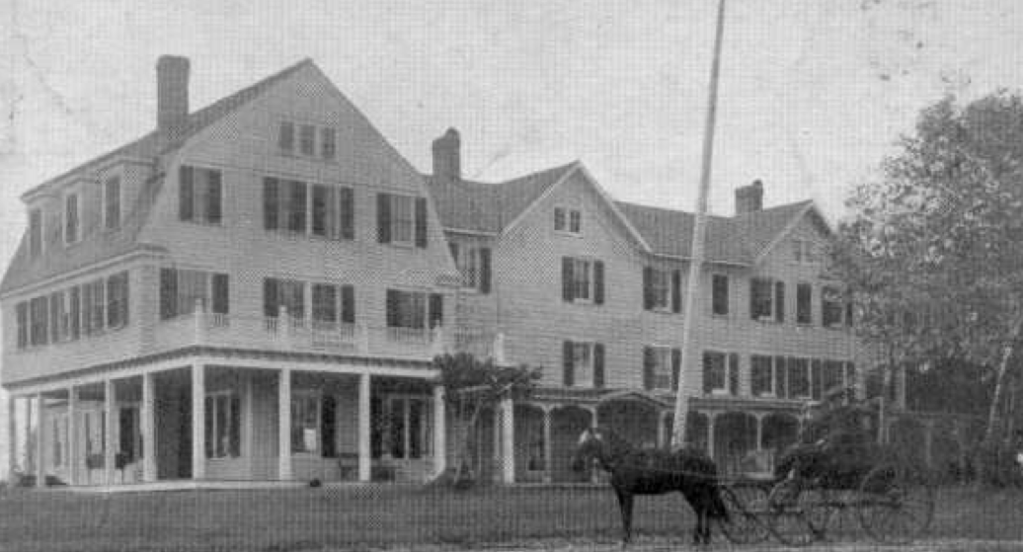
It was perhaps William that built the fabulous but now misplaced Bellows House at Good Ground. When Good Ground became Hampton Bays, a popular vacation destination for the wealthy, it is said to have become a beloved boarding house in the early days.
William Smith Bellows, son of John Bellows, had a son with the name John Bellows, who again lived a long prosperous life and begat many children including one William C Bellows born in 1837 and this is where our story comes back into focus.
William C Bellows was a fortunate son of a fortunate son. He’s loaded; from a wealthy, “landed” family planted deep in the bosom of the factory-owning-gentry utopia to the North.
William C proves to be the enterprising type and around 1870 he expands the Bellows footprint to a market on the water front “Bay St” in Beaufort, South Carolina, some several hundred miles south from the New York homestead. His motivations and antipathies are lost to time but he opened a bank account at the Freedman’s Bank in Beaufort. This was a branch of a bank instituted specifically toward the benefit of freed slaves, so we can guess at something of his ethics.
Beaufort, however, is no Charleston. Beaufort was spared the crushing blows of the Civil War and despite being caught in Reconstruction it was, is, and always has been gilded. Not a bad place to invest at the turn of the 20th century, or any century.
Consider his very northern money coming into a very southern environment after the Civil War, and while we may not know how wealthy William C was, he did well enough to have a storefront and a bank account. Northern capital drawn by the righteous dismemberment of the power structures of the slavery based southern economy. Yankee money chasing newly opened frontiers.
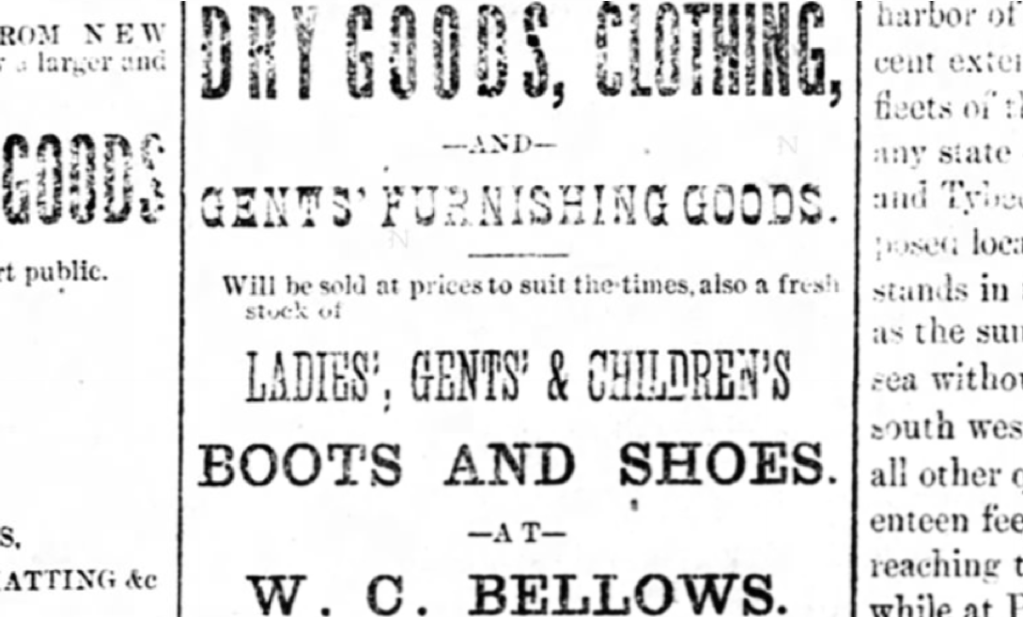
In 1872 in Beaufort he married Martha Atkins of the Delaware Atkins. In 1885 they rewarded the world with a son named George Francis Bellows.
George F was born and raised in Beaufort by a northern well-to-do family. He would have been educated, erudite, and savvy. He would embody the habits and customs of the rich. He would navigate situations of capital with a natural hand. He would have read books, he would know how to dress, how to walk like a rich man. He would be “worldly”. He was 18 years old when his father died in 1903.
How exactly Miss Lily and George Francis met has been lost to time. The evidence that transcends the clock and proves their union is that Lily gave birth to George Francis Bellows Jr. on July 8th 1909. If not for his birth their entanglement might never have been recorded; so fleeting their encounter.
The family gossip is that George (Sr.) was from a knickerbocking, protestant family of New England longjaws. He and Lily were “forced to divorce” by the down-the-nose-gazing uppities of the extended Bellows clan. It is worth noting that this is the first in three instances of Miss Lily being married without extant record. A Charleston historian upon query suggested that either she was married only in “Common Law”; or in the back room of a church by a hurried shepherd; or simply not married at all.
One can imagine a panoply of logistics that could produce George Jr.
Was Lily, broke and broken, taken advantage of or abused by a cruel and over-smart huckster? Or did she try to turn her tables by securing the child of a rich man against his general will? Were they lovers of choice or happenstance? Was she a “floozy”, chaste, or merely aloof? Were they friends or was their consummation a clumsy drunken accident?
Her disposition would have been influenced by her circumstance and age is a considerable costume. Who she was in 1908 and who she became might not be similar at all. What we can say for sure is that Lily was, for a moment, tied to a wealthy, educated man of Northern extract from a large and prodigious family.
Consider her culture shock. Lily worked in a bag factory and lived with three other adults in a 750 square foot shack nestled within the tailings of rusty capitalism. She had seen horrors untold and family members whisked from this earth by suffering and disease. Her twin sister, her father, another sister.
With a gust of wind she found herself in the arms of an incredibly wealthy and acculturated man.
Safe. Rescued. Secured.
With a gust of wind she is alone again.
George Bellows abandons her. Now in quick fashion several events occur.
The “divorce” of Lily and George, same as their “marriage”, is either unrecorded or the records remain cloistered away in a damp basement unfound.
Fourteen months after George Jr is born of Lily, George Francis marries a different woman to glorious pomp, this time well recorded. Immediately following the wedding and in routine annual fashion Abalonia Fredricka Bellows focuses on expanding the Bellows family footprint into the Carolinas, bearing a child a year for five years. Barbara and Susan in 1911 and 1912 respectively, and in 1913 Abalonia gives birth to George D. Bellows – George Jr.
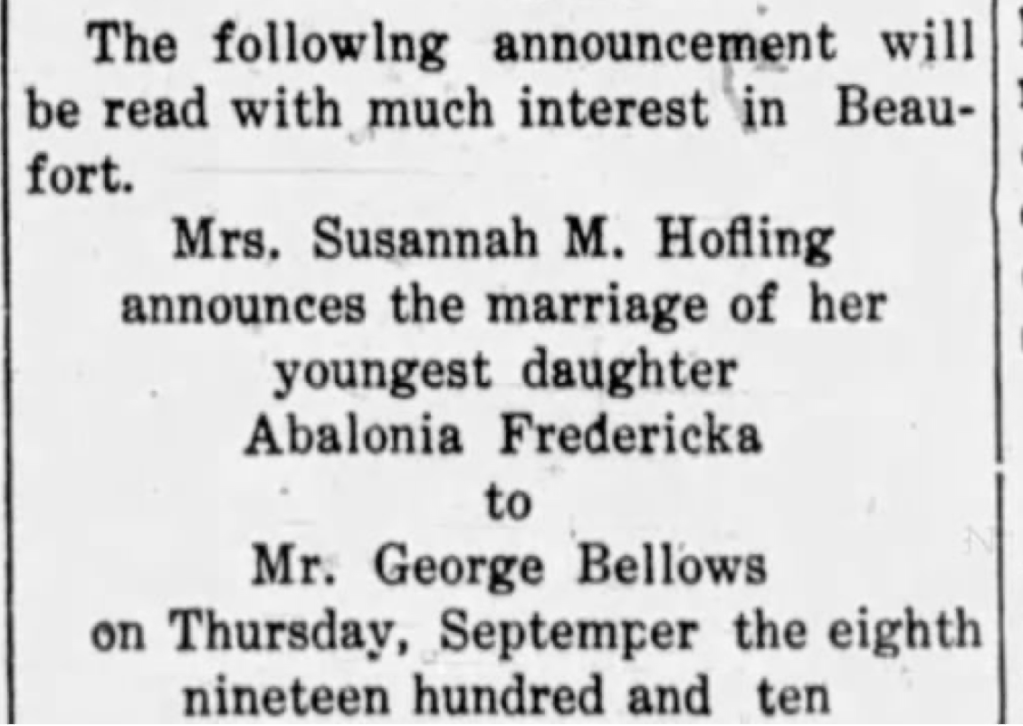
For those keeping track, this makes for two George Bellows Jr.s – one from 1909 and a party to Miss Lily Dolan; and now in 1913 this other, let us say, legitimate George.
As far as the Bellows family side of this story is concerned the entire Dolan family and the apparent improprieties of George Sr. were erased. They went so far as to have their own George Jr. That’s a special kind of cold blooded.
The Bellows family, for what it is worth, are due no ill will. All families have strange features hidden in the knots and gnarls of their ancestry that appear when you gaze long enough, so we say farewell to the legitimate Bellows as we move forward in time.
Lily Dolan persists at 62 r Line Street, living with her mother, younger brother Thomas, and occasionally her older sister Marie for the next four years – now with the addition of her fatherless child, George Jr.
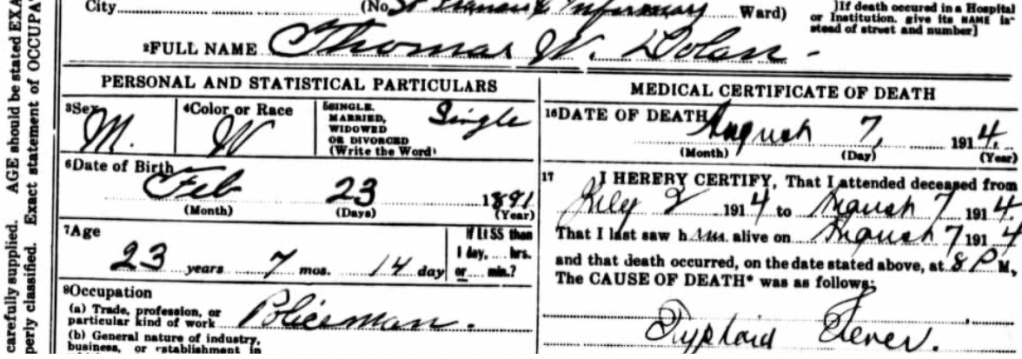
Thomas is alternately at school, employed, or between jobs and then in 1913 he becomes a policeman.
The scene lends itself to a cartoon, what with the child of impoverished Irish immigrants becoming a police officer in Charleston. It would be a solid chuckle were it not for Thomas dying of typhoid fever less than a year later. He was 23 years old.
The city gives, but the city takes.
Six months later Lily’s mother Janie Keegan died of pellagra and asthenia, fancy words that mean vitamin b deficiency and general weakness. We’ll have to imagine the lack of basic nutrition that leads a person to die this way at the age of 63. Was Thomas’ employment a last effort at solvency that failed when he died and cost the family their mother?
Down, down, down the dark well of sorrow.
For Lily, just more death. Another payment to unknown masters at the exchequer of creation.
Now the year is 1915 and Lily lives at 62 r Line St with her six year old son estranged from a rich man, having moved neither up nor down the long ladder. Beaten and bedraggled.
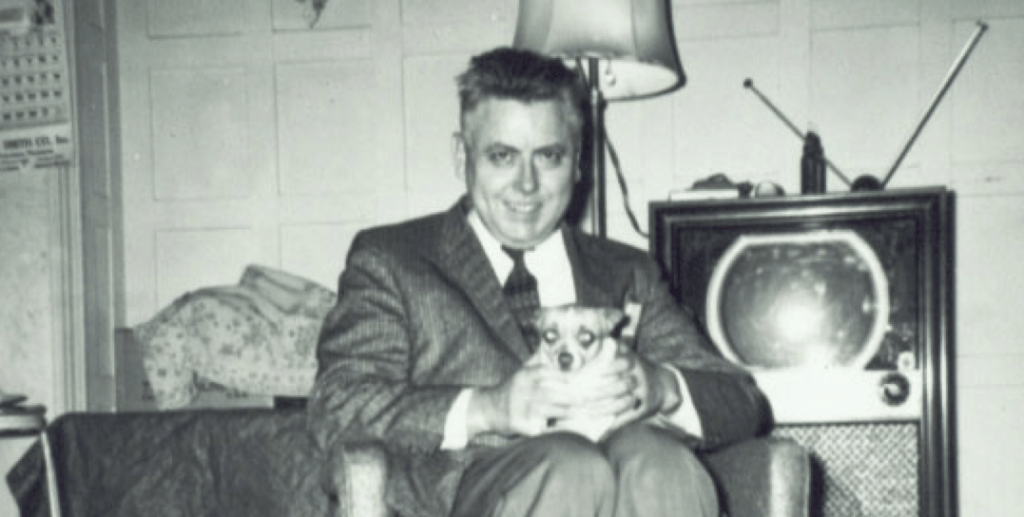
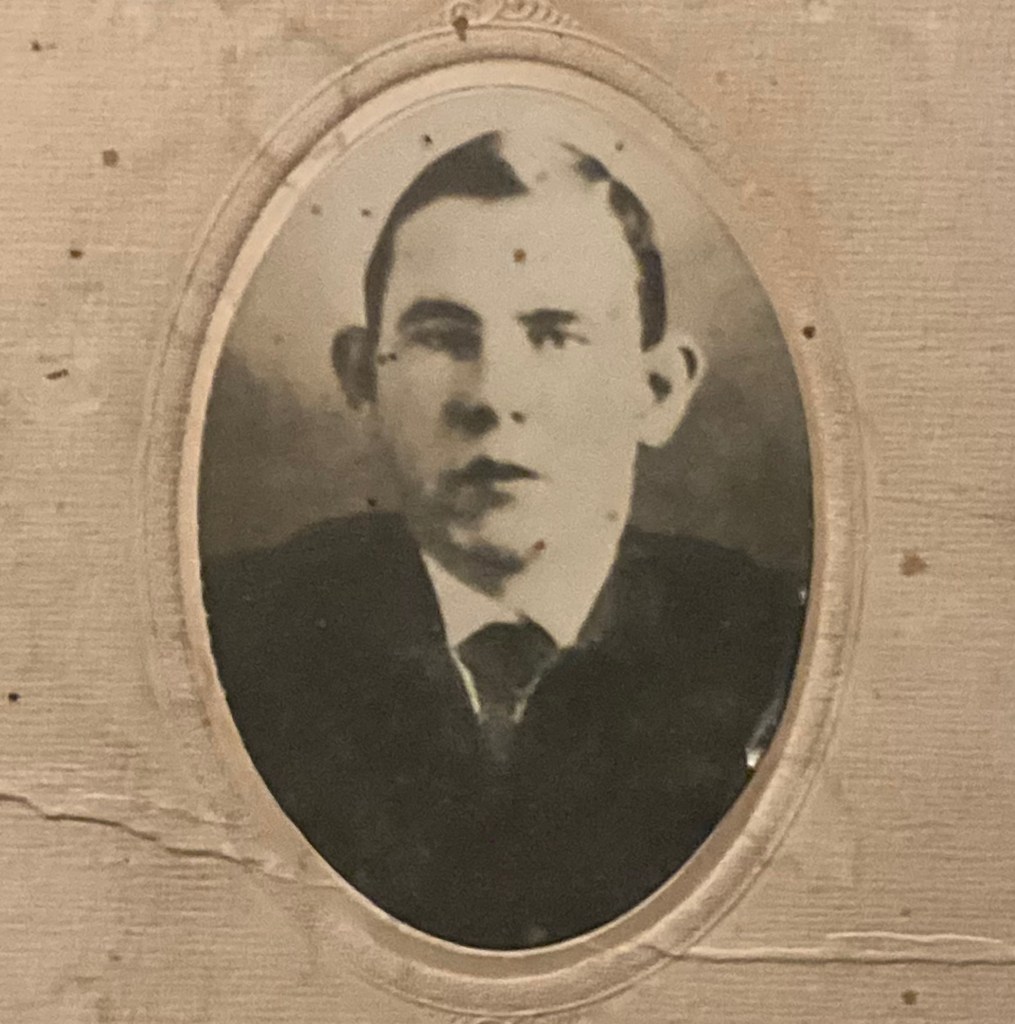
Jack Southford now appears from a haze of nothingness. All that exists of this man is a single photograph and less than half a dozen references on paper. Now that you have seen his photo you know just as much about him as anyone. Except of course, that he was a fabulous liar and con man.
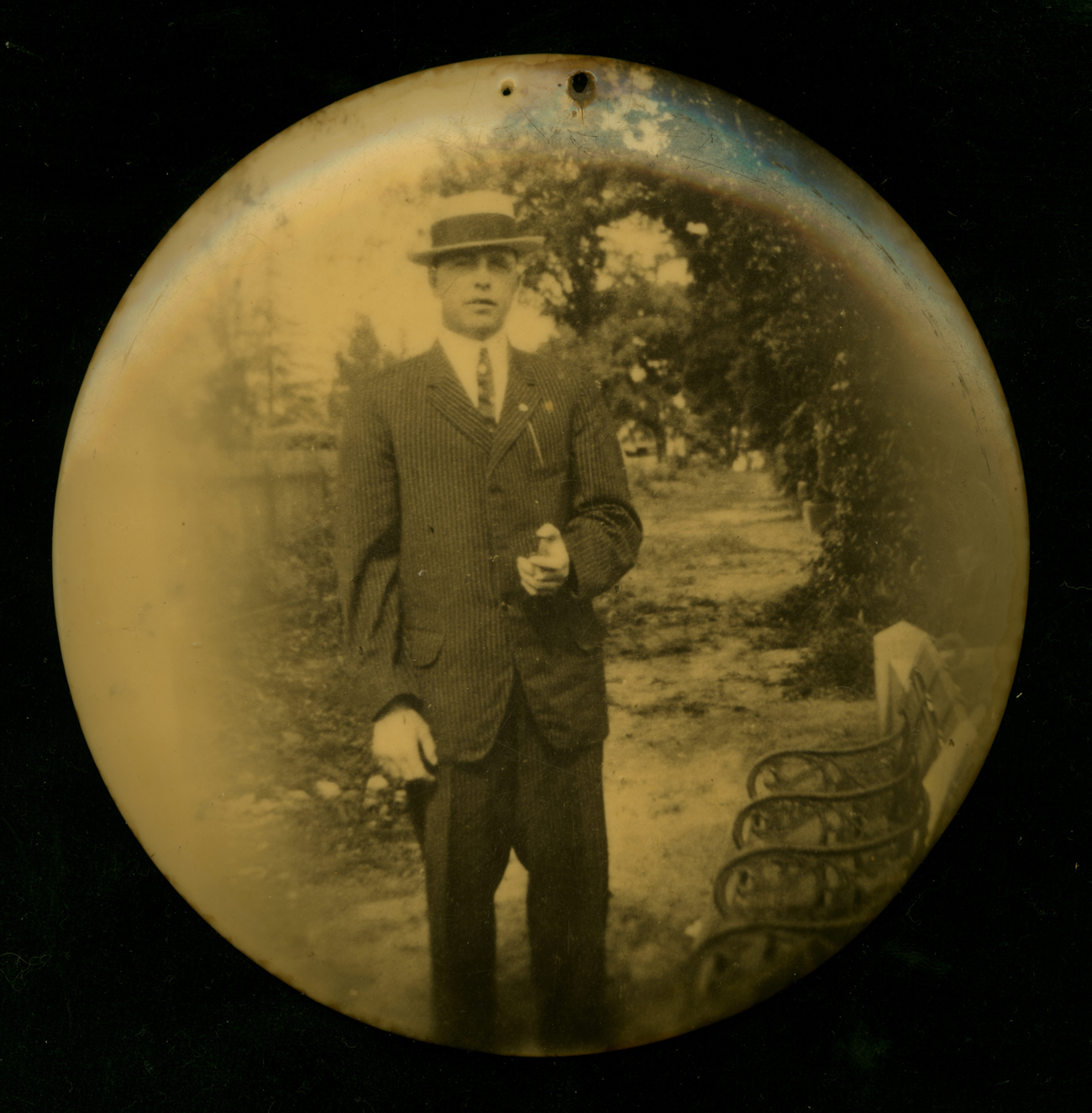
Nothing can inform us when and how Lily and Jack met. Like the landed knickerbocker father of her first child, he worked for the rail. Likewise, the only evidence of their union are his contributions to the Dolan gene pool. Jack Southford and Lily Dolan had a son, Jack Jr, on February 7 1916, and a daughter, Jennie, March 28 1920. Jennie was my Grandmother.
The latest Jack and Lily could have became acquainted is Spring of 1915, and one might hope they knew each other for some time before choosing to consummate their marriage – which incidentally – there is no record of.
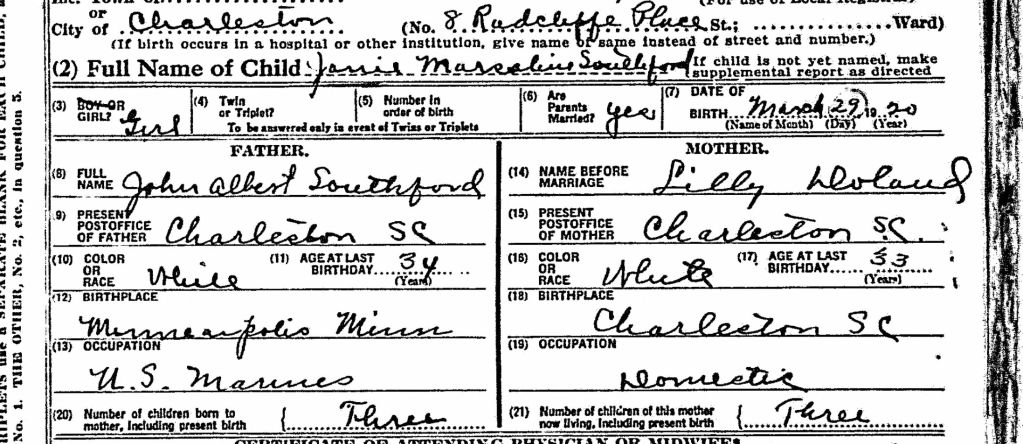
The records that do exist are Jack Jr’s and Jennie’s birth certificates. They state that their father is a Rail Road Conductor named Alvin H Southford and four years later a US Marine named John Albert Southford, both from Minneapolis, Minnesota.
For the record there are no Southfords in Minnesota. Or anywhere.
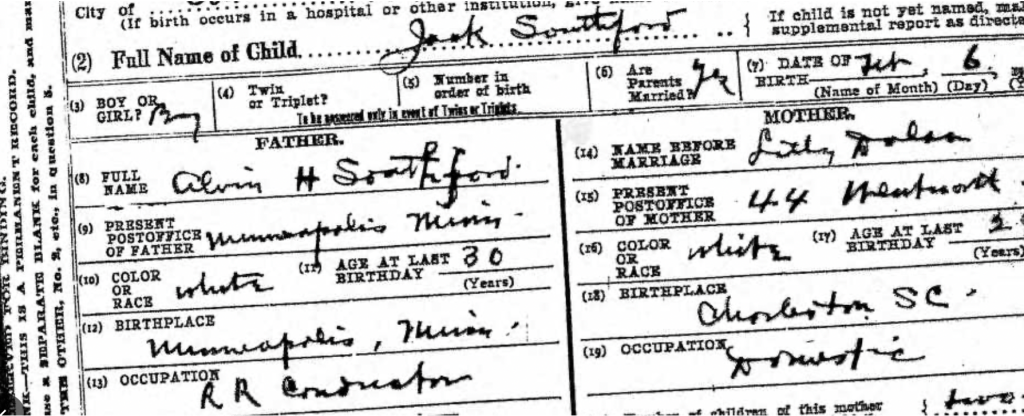
In 1916 Lily, presumably with George Jr, has moved around the corner to 8 r Ashe St in essentially the same neighborhood. Here she lives still with her sister Marie. There is no mention of a Jack or Alvin Southford at this address. Neither is there such in 1917 or 1918. If Jack was there, he was quiet about it. The 1916 record lists his “current” post office as Minneapolis, suggesting he was at first merely visiting Charleston. A railroad conductor seems like the kind of career that would excuse one from home for great stretches of time
The 1919 Charleston directory lists John L Southfourd (with the erratum u) as living at the Ashe St address with Lily. It lists his employer as U. S. A. This directly predates his disappearance. Their second child is born after he vanishes and she never met him. On her birth record from 1920 her father is listed as John Albert Southford, a US Marine; he would have been “missing” for some months by this time.
The family story is that Lily called on the Marines after some time and asked where her husband Jack Southford was to which they replied they had no such record. He made it up. A fake name, fake career that facilitated long stays away. If we trust the paperwork, we might surmise he only spent several months in Charleston.
Decidedly on the rocks, at the behest of her priest Lily sends her children and eventually herself to live at the Narareth Boys Orphanage in Raleigh North Carolina, now site of the infamous yet erroneous haunted Crybaby Lane. From there they removed themselves to Baltimore and a new, different life.
Lily married a third time, unrecorded as the others, to a man named LeMay who then died six years later. He is an especially hard person to track because he was so unremarkable. A baker, and a son of a baker – the spectral opposite from the aristocracy of Bellows.
She spent her elder years as Lily LeMay, near her sister Marie and son George and then passed on, let’s suggest happy and in peace, at the age of 94 in 1979. She is buried next to George Jr, who had died two years prior and it seems never married. Her other two children, Jack Jr. and Jennie both married and had children, creating the most minuscule “legitimate” footprint of the Southford line. The truth is we’re all bastards.
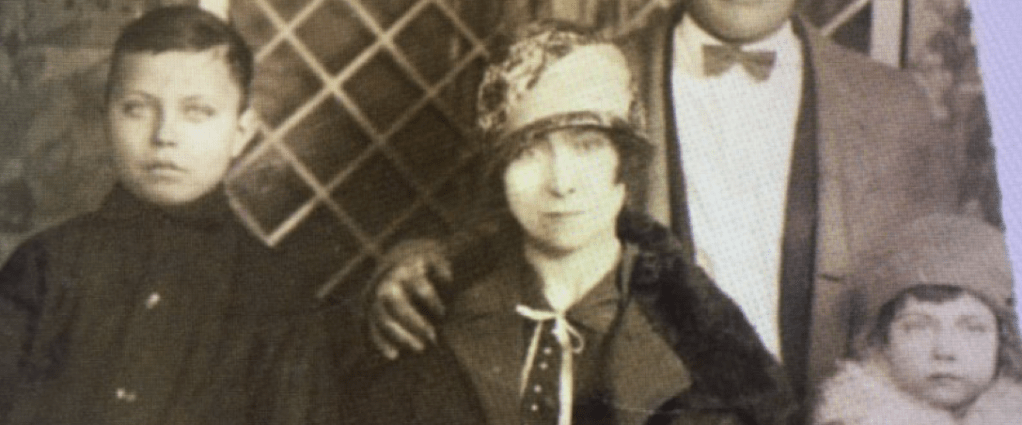
Jack Southford never appeared again.
 Jack Southford